


Spring is a time when we long for the first flowers and leaves. In this article, you will learn which ornamental trees and shrubs are most often planted in our gardens, as well as which of them will develop leaves and flowers the fastest.
Deciduous shrubs in the garden — just for hedges?
We are increasingly moving away from using shrubs in the garden solely as a row of evergreen conifers to separate us from the prying eyes of neighbors or a busy street, and instead opting for species that are more decorative. The most popular varieties and species of deciduous shrubs that we most often plant in our gardens include:
- magnolias,
- spurge laurel (mezereon),
- common and Turkish hazel,
- Japanese barberry,
- forsythia,
- common privet,
- common hornbeam,
- scarlet firethorn,
- weigela,
- common boxwood,
- lilac.
Magnolia — a striking plant with decorative flowers
The magnolia (Magnolia L.) is a genus of shrubs, and more rarely small trees, from the magnolia family (Magnoliaceae). It occurs naturally in North America and East Asia. Some species of the genus Magnolia are successfully grown in Poland as ornamental plants. The most commonly planted are varieties of saucer magnolia and star magnolia, which has been grown in Poland since the 17th century.
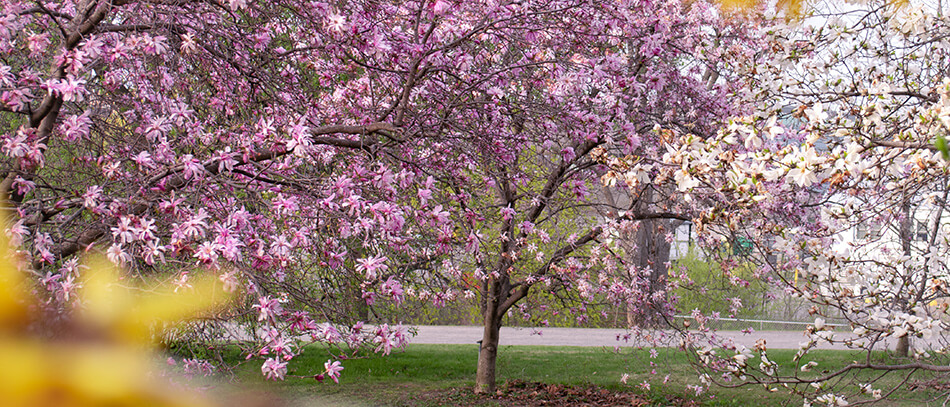
The beauty of the magnolia is enchanting every year, but it is short-lived.
Magnolia — the flowering symbol of Wrocław
The magnolia tolerates difficult urban conditions very well. For the residents of Wrocław, a magnolia in the garden is almost a necessity. It is often planted at entrances as a representative accent and the main decoration of a building. Its striking habit and decorative flowers blend perfectly with the Art Nouveau facades of Wrocław's tenement houses, but it is also appearing more and more frequently in the surroundings of modern buildings.
There is a reason for this — the saucer magnolia delights with abundant pink and white flowers every year from the beginning of April. The end of its flowering usually falls in the second half of May. However, there are varieties and species such as the star magnolia (Magnolia stellata) that bloom at the turn of March and April.
What are the requirements of a magnolia?
For a magnolia to bloom profusely, it needs fertile and permeable soil.
It does not tolerate sandy and poor soils. It is worth thinking about this before planting and digging a large hole in the target spot where a layer of rich soil will be placed.
Magnolias grow best in slightly acidic soil. After planting, it is good to mulch the soil with bark. This will help avoid weed overgrowth and retain more moisture in the substrate.
How to choose a spot for a magnolia?
This shrub grows slowly and feels best in sunny positions, but it also tolerates partial shade. Although we have frost-resistant varieties, it is worth planting magnolia seedlings in a place sheltered from the wind. This will prevent the plant from potentially freezing. Young specimens should be additionally protected in autumn and winter, and cared for with regular watering in summer, as they are sensitive to droughts and frosts. For this purpose, straw mats or agro-textile can be used, and an irrigation system can be installed. Mature specimens are frost-hardy, however, they should not be planted in the colder regions of Poland.
Spurge laurel (mezereon) — a common and fast-growing honey-producing shrub
The spurge laurel (Daphne mezereum L.) is a shrub belonging to the Daphne family. It is a species native to Europe and Asia Minor. This ornamental shrub occurs relatively rarely in its natural environment in moist deciduous forests. It is, however, a popular and valued ornamental plant. Although its flowers are small, they delight with an intense fragrance.
It produces small, purple flowers. Usually, the flowering of the spurge laurel falls in March and April, but in warmer regions of Poland, it can bloom as early as the end of February. After flowering, it produces entire, ovate, dark green leaves that turn golden-orange in autumn. The spurge laurel is a honey-producing plant, contributing to the preservation of the biodiversity of native fauna. In July and August, it produces decorative fruits with a shiny skin.
Where to plant spurge laurel?
Spurge laurel grows best in shady and semi-shady positions. Unlike the magnolia, it prefers calcareous soils with a slightly alkaline reaction. It does not tolerate drought. It is important that the soil is rich in humus and well-hydrated. Otherwise, the spurge laurel will grow poorly, and the flowering will not be abundant. Apart from this, it is a plant with low requirements; it is resistant to frost and winds.
How to care for a spurge laurel?
The spurge laurel is a slow-growing shrub that reaches a height of up to approx. 1–1.2 m. Pruning should be limited; remove only shoots encroaching on paths or other plants. One should ensure good soil, rich in calcium compounds and water. In spring, it is good to nourish the soil with a dose of compost or manure.
Hazel — the earliest blooming native species
Although hazel is more often associated with hazelnuts rather than lush flowers, it is one of the species native to the Polish flora that develops flowers in early spring. It provides a great background for bulbous plants growing in the spring.
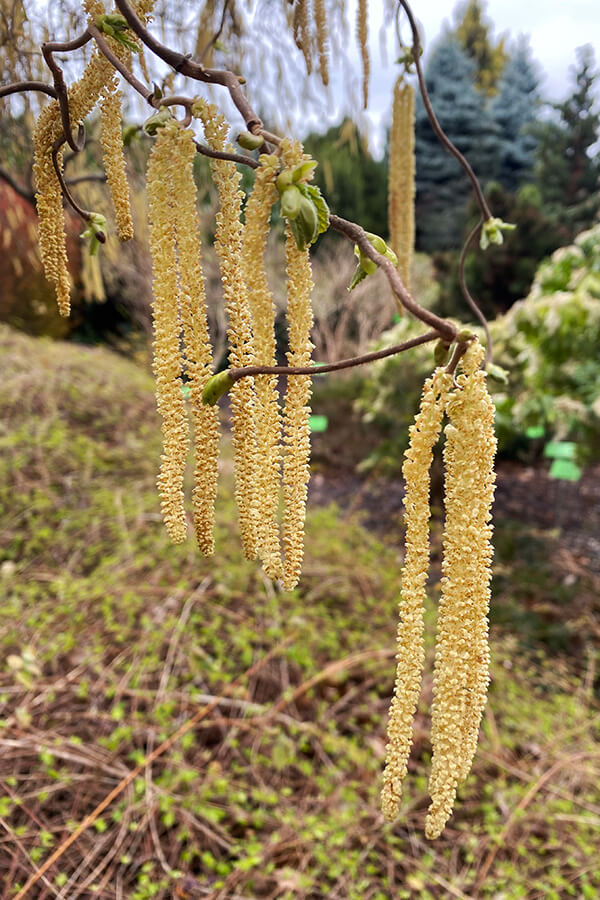
Generally, it grows to a height of about 3 m. Usually, the green and yellow male flowers, also called catkins, develop between February and March, but this year it happened as early as mid-January. Observing climate and weather changes, it can be assumed that such anomalies will occur in subsequent years. Depending on the variety, hazels develop leaves only after flowering ends, i.e., at the turn of spring and summer.
What do hazel flowers look like?
Speaking of hazel, it is worth noting that it is a plant that produces two types of flowers — male and female, which appear at different times. Protandry occurs, where male flowers appear first, or protogyny, where female flowers appear first.
The male flowers are in the form of yellow, pollen-shedding catkins, which usually appear before the leaves are produced. The female flowers are inconspicuous; they look like leaf buds tipped with a bundle of red threads.
SOURCES
Seneta, W. (1994). Drzewa i krzewy liściaste. Państwowe Wydawnictwo Rolnicze i Leśne.
Bojarczuk, T., Bugała, W., & Chylarecki, H. (1980). Zrejonizowany dobór drzew i krzewów do uprawy w Polsce. Arboretum Kórnickie, 25, 329-375.
Jarosz, Z. (2007). Nawozimy drzewa i krzewy ozdobne. Działkowiec, (04), 26-27.
Chylarecki, H. (1974). Ocena odporności na mrozy wybranych drzew i krzewów w Polsce oraz selekcja matecznych egzemplarzy magnolii. Arboretum Kórnickie, 19, 46-79.
Bojarczuk, T. (1993). Drzewa i krzewy ozdobne [dobory, sadzenie, pielegnacja]. Ten Świat, (1), 1-2.